Off-target liability rating for — most potent siRNAs selected from — siRNAs
Examine on- and off-target activity of individual siRNAs
On-target activity
Loading predictions…
Off-target profile: High-Confidence Off-Target Predictions vs String-Matching
Loading predictions…
Cutoffs
* Based on a virtual screen using DeepRNAi predictions. See Validation and Details.
Validation and Details
Sequence MatchingString-matching methods count 1) off-target transcripts with a near-perfect match (NPM) anywhere in the mature transcript allowing up to two mismatches across guide nucleotides 2–16 and 2) seed matches (7mer-m8, 7mer-A1 or 8mer) in the 3′ UTR.
High-Confidence Off-Target PredictionsDeepRNAi predictions at our High-Confidence threshold had a 65% experimental validation rate in RNA-seq.
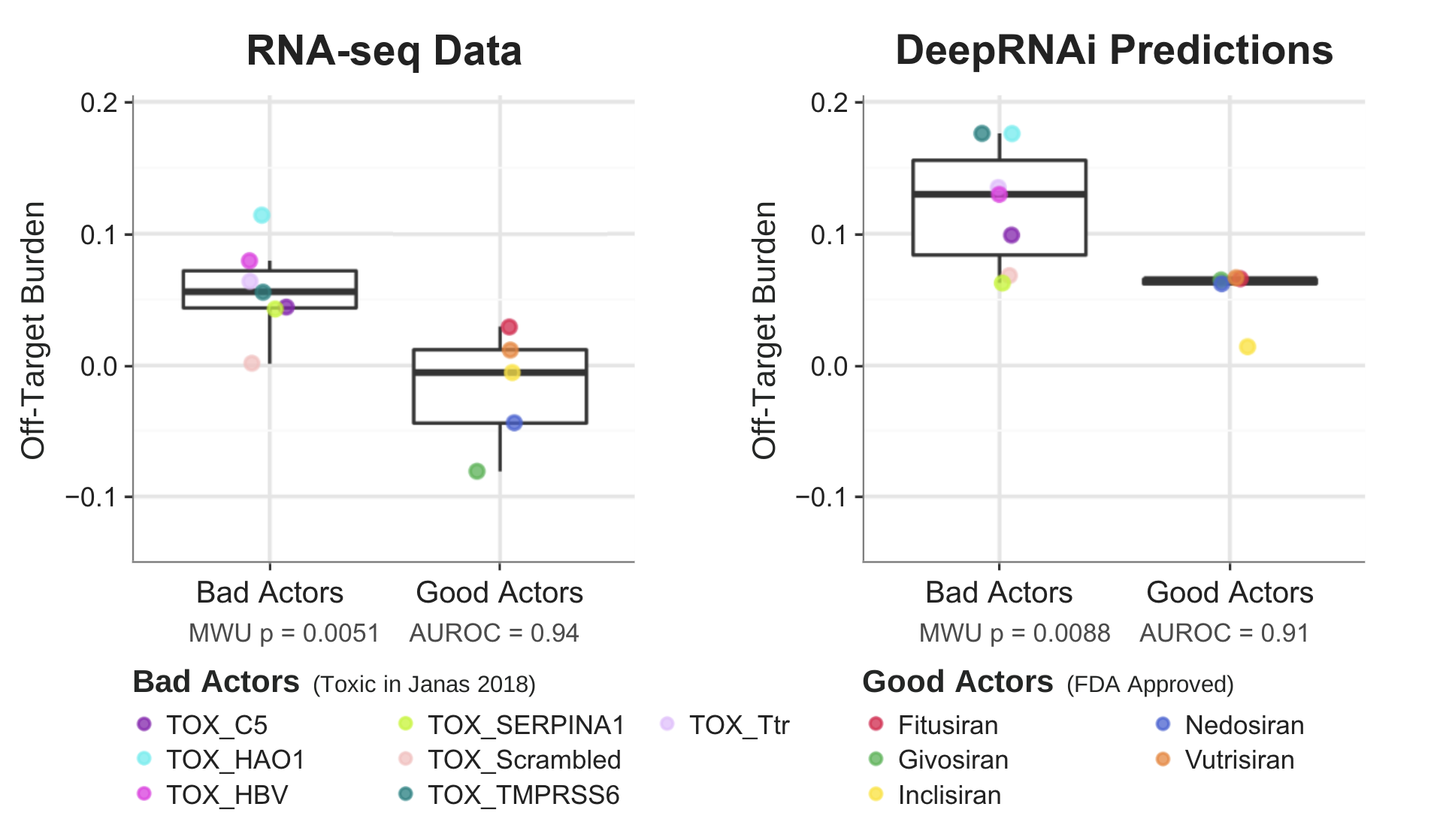
Off-Target BurdenOff-Target Burden measures the global seed and NPM knockdown activity of an siRNA. When comparing our RNA-seq data for hepatotoxic compounds from the Janas 2018 study (“Bad Actors”) to five FDA-approved siRNA drugs (“Good Actors”), we saw a difference in the overall Off-Target Burden that could distinguish these two classes. This separation in Off-Target Burden was well-predicted by DeepRNAi.
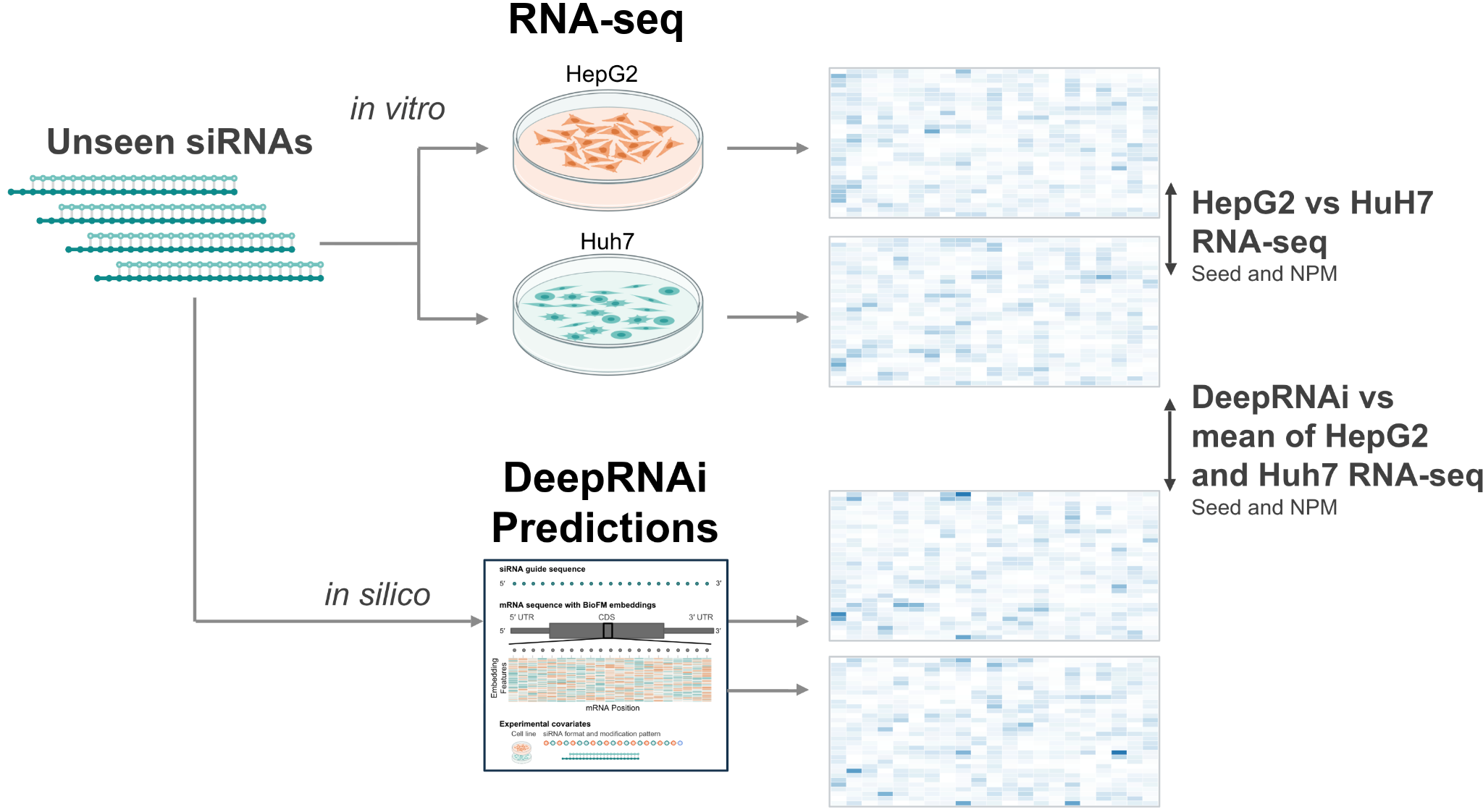
DeepRNAi Predictions Approach RNA-seq AccuracyThe same unseen siRNAs were tested independently in HepG2 and Huh7. We compared agreement (Pearson correlation) between these experiments to DeepRNAi predictions for NPMs and seed matches. The experiments in different cell lines were compared to each other, and DeepRNAi predictions were compared to the mean RNA-seq response across two cell lines.

Case StudyIn a virtual screen of 3,615 siRNAs for potency and Off-Target Burden for siRNAs targeting PCSK9, DeepRNAi ranks Inclisiran as one of the most potent compounds with low Off-Target Burden.
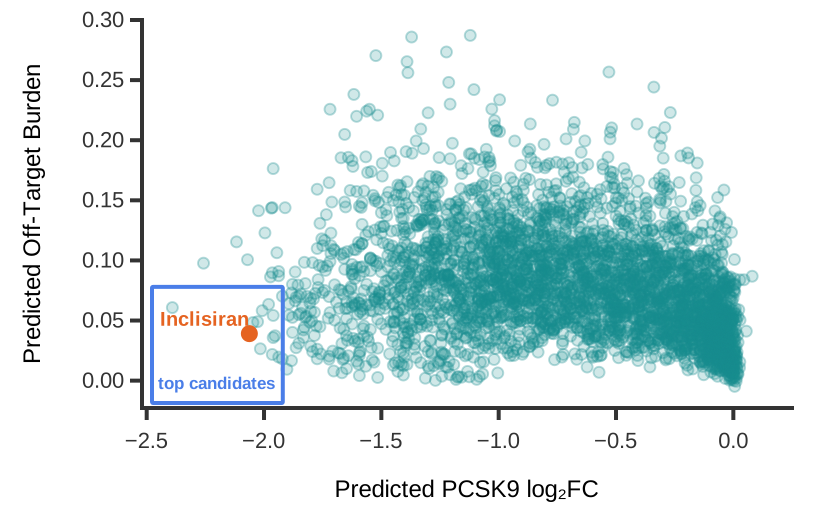
Design setEvery siRNA for the target transcript was scored for on-target potency, and the 100 most potent were retained for off-target profiling.
DisclaimerA Low Liability or Negligible Liability rating does not establish safety. Similarly, a Moderate Liability or High Liability rating does not imply toxicity. As per FDA guidelines, all candidates require experimental follow-up.